
Three 1970s Freak Concepts
Let's open a certified classic folder today.

It has been a long week here. Many things have happened. I suppose this describes every week.
Let’s change gears for a second and look at three dichotomies laid out in Robert Anton Wilson’s ‘Illuminatus Trilogy’. Just some interesting ideas to flip around.
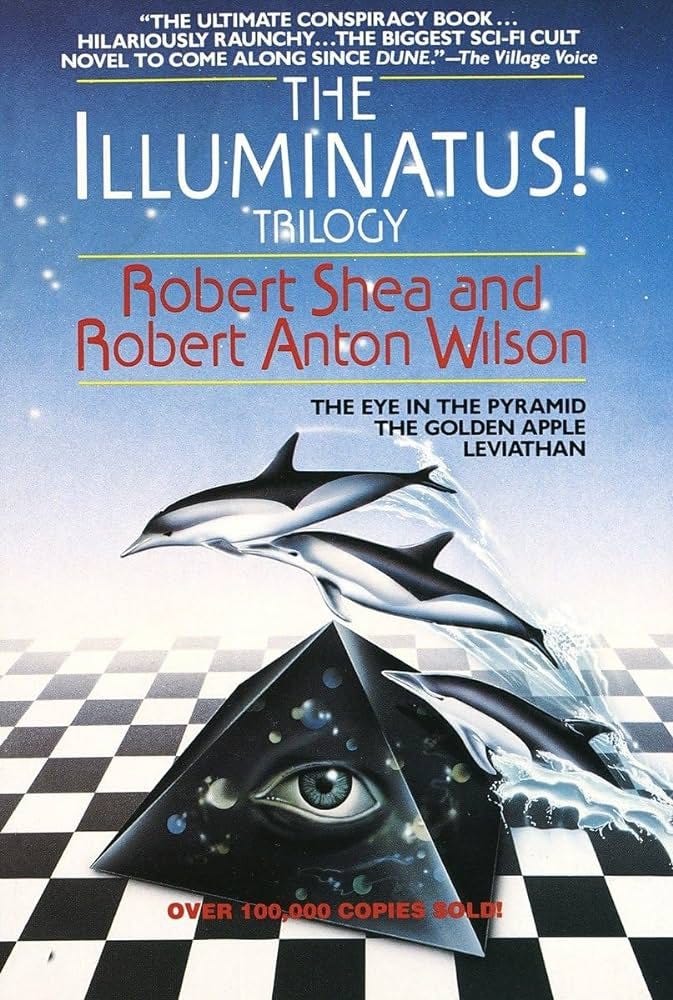
In some ways this book is not our typical subject matter. Containing, literally, one of the most blasphemous literary scenes that I’ve personally encountered, and generally anti-religion and tradition in a way that might later be described as “reddit”, slightly pornographic - it’s generally adjacent to drugs and being a hippie in a way that enshrines and elevates those things.
However, in other ways, this is a seminal work in the history of weird American thought, being a weird person in general, and overly cerebral nerdy guys who like religion. So, here we are.
One of the book’s strengths, aside from a long insane winding narrative, is interesting concepts.
I find the word concept very useful: “a concept” feels like “an active idea”. It’s an idea you can do something with: deploy, climb inside - you can often use it as a lens to apply to whatever other topics you happen to be presently interested in.
This book is very influential. So, just for fun now, let’s look at three lesser discussed concepts from it.
Emperor Norton and Boston Anarchy Money
Emperor Norton was a real person who lived in the 1800s. I believe he was a homeless guy from San Francisco who declared himself sovereign emperor of the United States. People thought this was cool, and funny, so they started treating him as an actual aristocrat.
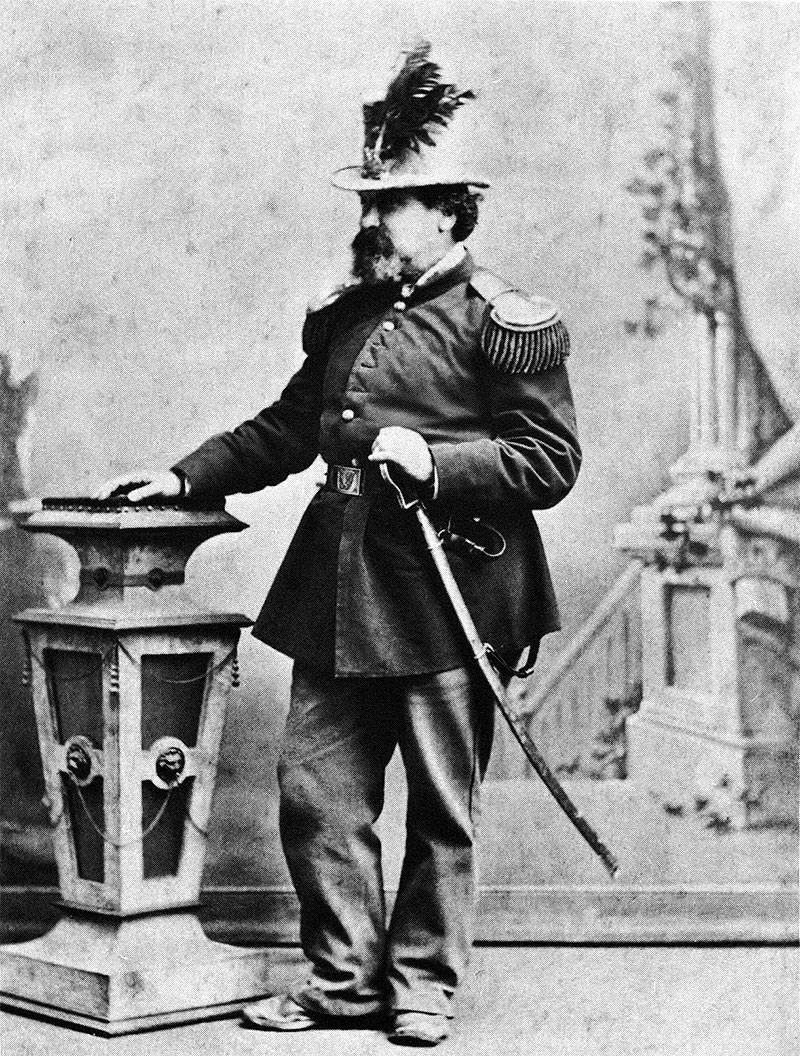
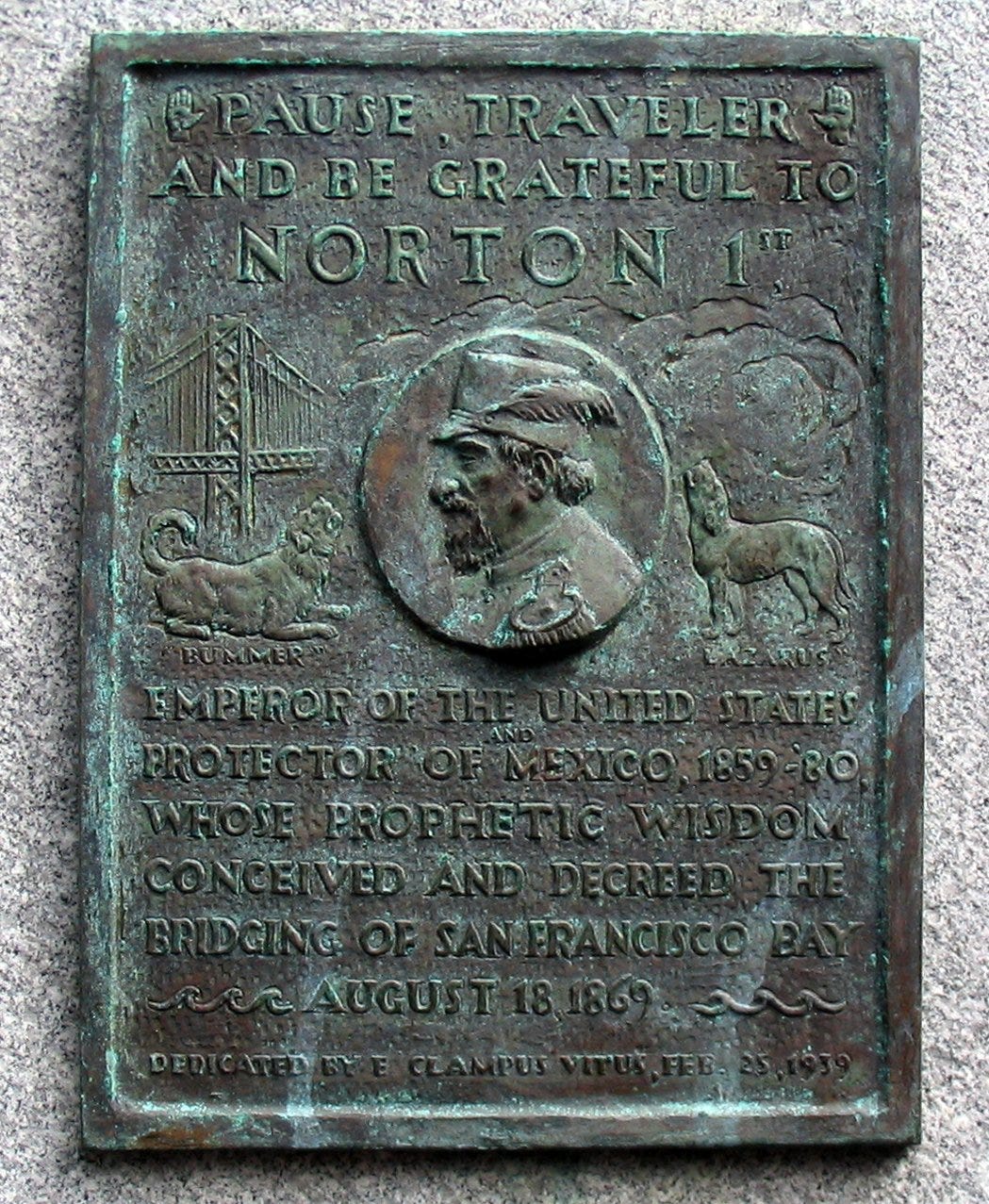
Restaurants started reserving a permanent seat for him, people would bow to him in the street. He even got a plaque and maybe a statue.
Meanwhile, on the other side of the country, there were anarchists in Massachusetts who started publishing pamphlets about their own work, unaware of this weird guy wandering the streets of San Francisco.
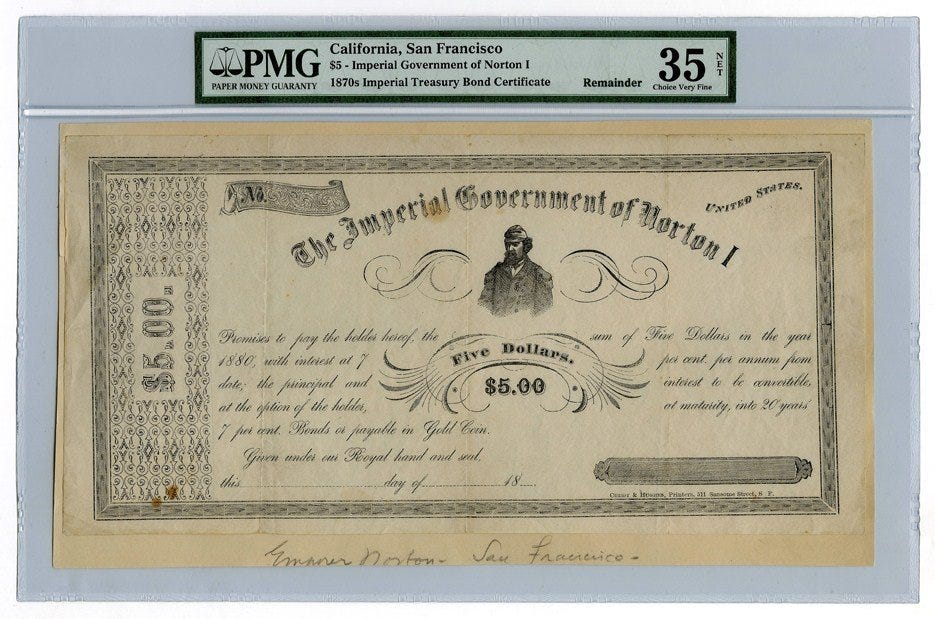
These pamphlets were all about radical localism: hyper-local leaders, communities, and most importantly, hyper-local currency. The idea was that local communities could print their own currency, and this would gradually weaken the US government.
They started printing currency.
As soon as they tried circulating their currency, they were all arrested.
Well, it just so happens to be the case that a man they knew nothing about, in California, was circulating his own money - and local shops and people were using it. His name was Emperor Norton.

After declaring himself emperor, he naturally made some currency, and some people used and accepted it because it was cool and funny.
The point of this dichotomy is that Emperor Norton actually did the exact plan that anarchists on the other side of the country also attempted and failed - but he got away with it, specifically because no one took him seriously.
The anarchists presented themselves as serious, and thus were treated seriously. Emperor Norton was viewed as non-serious, and therefore was able to accomplish far more than his serious counterparts.
Biograms vs. Logograms
This one is simpler, but I have found these terms and this general dichotomy useful in a variety of fields.
The idea is that every person has “biograms” - “sets” or packages of biological information and tendencies: desire for sex, hunger, and so on.
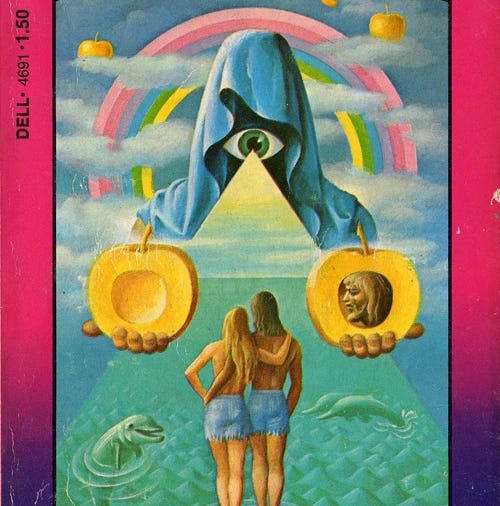
These biograms exist in harmony with or in opposition to a person’s “logograms”. Logograms are informational programming we have: beliefs, ideologies, general concepts, and so on.
A person’s general state flows from the interaction of these two different informational structures - they shape each other. You have an innate bodily desire for sex - that’s a biogram. That desire is given form by your logograms. If you’re a monk, your logogram takes that biogram (desire for sex) and packages it in a certain way and suppresses it. If you’re a new age guy living in a loft in Brooklyn, you have a totally different logogram regarding this. That same biogram (desire for sex) is going to be given a totally different expressive form.
And, it flows the other way. If someone’s logogram says it’s good to eat a particular food, you may actually experience that as a biogram - hunger for that particular food. Someone who suffers from anorexia has their logogram (essentially, do not eat) in opposition to their biogram (biological need for food).
I would say stress and anxiety also fall into this in an interesting way. If your logogram says, “I can’t sleep, I need to accomplish an inhuman amount of work”, that’s going to be in opposition to the biogram of “need for sleep”. It’s not the whole picture, but that’s one aspect of what stress and anxiety really is.
As the book was written in the 1970s, it’s basically set up so that to have the logograms in opposition to the biograms is a bad thing. However, I think it’s more interesting to go a level deeper and ask what the ideal interaction between these two would be.
Neophilic vs. Neophobic
I chose this as the last one because it has a cool narrative illustration. The concept is that humanity is split between people who are neophilic - they like things just because they are new, and people who are neophobic - the opposite: people who dislike things because they are new.
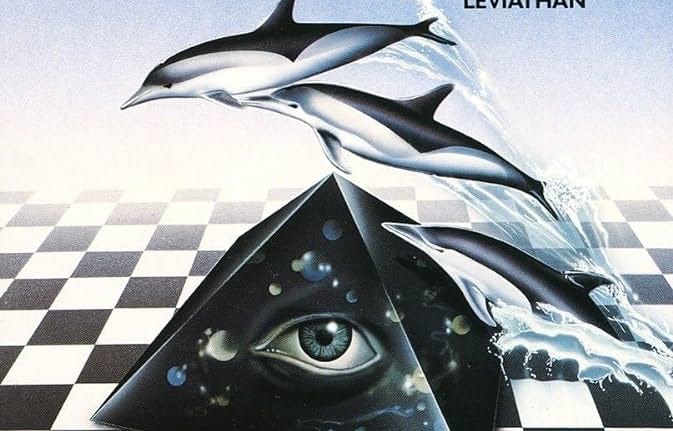
People who are neophobic dislike new things just because they are new. We might recoin the term as protophilic or paleophilic and say they like old things just because they are old. Perhaps a linguist can get us away from this unfortunate suffix, if they find this worthwhile.
Anyway, in the book, there is a drug called AUM, and if you give it to someone, it induces a type of hyper-neophilia in them. For example, the main characters are at a party, they give this guy AUM, and everything they say to him, if it’s a new idea, he just agrees with it and accepts it 100%.
So they say, “maybe the shape of the earth is like a carrot, and we live at the top”, and he just says “yes, totally. Wow, that makes perfect sense”. Any new idea is just uncritically accepted.
I liked this moment because it seemed to be a slight self-awareness poking through. The book has an extremely 1970s hippie nerd drug vibe - for lack of a better categorization. It became extremely influential in early internet culture (if you’re familiar with the term fnord, that’s from this book).
So, all the content is tilted in that direction - something like “drug and technology new age magic”. Except this one.
It felt like a moment of self-awareness to include a drug that makes people so open minded that they become susceptible to anything, even if it’s obviously a lie, just because it’s a new idea - in the middle of an epic specifically celebrating drugs and spiritual novelty.
I’d guess the book is around 900 pages. If you haven’t read it at this point, if it’s not part of your path already or your current studies, odds are you may never read it. So there’s a few concepts I have enjoyed thinking about and that have often resurfaced for me since I read it many years ago.
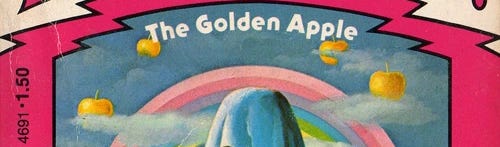
If you’re a weird internet person interested in religion, you may also be familiar with this book. Just a cool image to end on - I like the design work here. If not, we’ll cover this another time. Hope your week is going well.
![Principia Discordia : Loompanics [ Robert Anton Wilson ] - ELLIPSIS ...](https://substackcdn.com/image/fetch/$s_!n8-F!,f_auto,q_auto:good,fl_progressive:steep/https%3A%2F%2Fsubstack-post-media.s3.amazonaws.com%2Fpublic%2Fimages%2Fab3f5497-a767-43c6-9857-9a2c4b1a247f_1080x1080.png "Principia Discordia : Loompanics [ Robert Anton Wilson ] - ELLIPSIS ...")
A tangentially related article can be found here: ‘Festivus and Modern Magical Practice’. I also personally engage in the intersection of religion and creative activities, you can find all that here.
RAW is totally underrated. Or under discussed at least. He gets lumped in w Leary oft. But Prometheus Rising is far more approachable than Game of Life (Angel Tech may be fave of treatments however...) for eight circuit model. Plus Illuminatus! is fantastic fun. No Pynchon literarily, but good pulpy schlock of parapolitics.
Yano. He was also big Thelemite. And Leary was too. And both were IOT in 90s iirc.
Anyway. Would love to hear yr thoughts on Principia Discordia. I still think about Zenarchy wrt pacifism quite often. I also think RAW secretly grasped Nagarjuna's tetralemma in that book (principia) -- hah.
I read the book years ago, and to be honest I can't remember that much of it - it was a grandiose, sprawling mess.
Emperor Norton getting away with lots more because he wasn't serious is a brilliant observation.
(Philip K. Dick made a somewhat related observation when he said that if there was an alien invasion and the aliens all wore funny hats, we wouldn't be able to fight/defeat/stop them.)
(I have also observed that several real-life politicians in the past decade have found out how "clowning" can be an asset. If they don't take you seriously, you can get away with more...)